
Large events are a throughput problem first
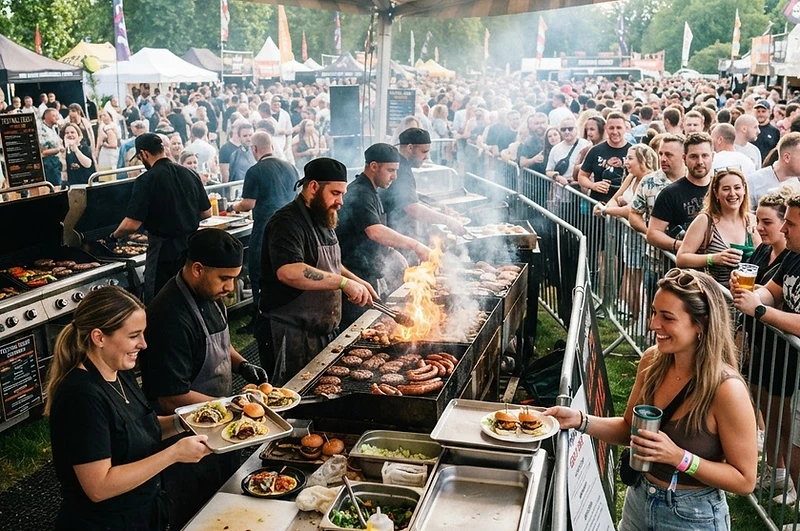
Before a single menu item is chosen for a large event, the real question is throughput: how many guests need to eat, across how many hours, through how many service points. Get that math wrong and you have a two-hour line, cold food and an event people remember for the wrong reason. On The Spot Catering plans festival and large-event catering backward from guests-per-hour, then designs the menu around what holds quality at that pace.
Chef Alec Ayala came up through high-volume hotel banquet kitchens before founding On The Spot Catering, and that background is exactly what large-scale service demands. We know how many hands it takes to keep four grills firing, how much prep has to be staged before gates open, and how to sequence production so the last guest served gets the same plate as the first.
We regularly cater events in the several-hundred-guest range and scale with additional stations, additional equipment and additional crew for larger counts. Multiple stations serving simultaneously — rather than one long line — is the single biggest lever on guest experience at scale, and it is how we design nearly every large event.
Events we cater at scale
Festivals and public celebrations — community festivals, cultural festivals, food and music events, holiday celebrations, city and municipal events — are core work. These usually involve a service window measured in hours with continuous demand rather than one seated meal, which means production has to run steadily instead of peaking once.
Corporate picnics and company appreciation events are among our largest private bookings: full-day outdoor service for employees and families, often combining a grill station, a taco bar and a dessert or drink station so different lines run in parallel.
We also cater concerts and live music events, car shows and motorsport events, sports tournaments and league days, county and community fairs, church and faith-based large gatherings, nonprofit galas and donor events, grand openings, warehouse and distribution center appreciation meals, film and production crew catering, and large family reunions and multi-hundred-guest celebrations.
Mobile kitchen, equipment and site logistics
We operate as a self-contained mobile kitchen. We bring commercial flat tops, grills, burners, holding and warming equipment, prep tables, sanitation stations, serving equipment and everything needed to run a full production line on a site that started the morning as an empty field or a parking lot.
Site planning is done in advance with your organizer. We confirm power availability and draw, water access and greywater handling, vehicle access and load-in windows, station placement relative to guest flow, shade and canopy needs, waste and grease disposal, and staging space for prep and back-of-house. Where power is unavailable we plan around propane and generator support.
Load-in and load-out are coordinated to your vendor schedule. For events with multiple vendors, security checkpoints or staged access, we work to the organizer's run-of-show rather than expecting the event to work around us.

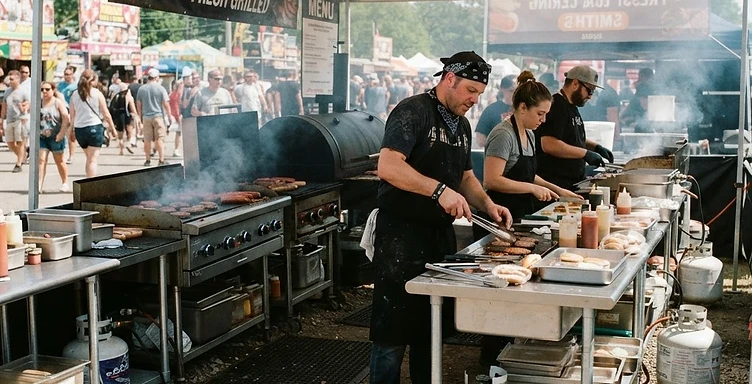
SELF-CONTAINED MOBILE KITCHEN — FESTIVAL SITE SETUP
What we plan before load-in
Power and water
Confirmed draw, generator or propane support where power is unavailable, plus water access and greywater handling.
Station placement and guest flow
Multiple stations positioned to split the crowd rather than funnel it into one line — the single biggest factor in wait times.
Load-in and vehicle access
Coordinated to the organizer's vendor schedule, including security checkpoints, staged access and load-out windows.
Permits and insurance
Temporary event food permits with county environmental health, plus certificates of insurance naming the venue, organizer or municipality.
Waste, grease and sanitation
Handwashing and sanitation stations, protected food surfaces, and disposal handled to permit standard.
Permits, insurance and food safety at scale
Large public events carry regulatory requirements that private parties do not. We coordinate temporary event food permits with Riverside County and San Bernardino County environmental health requirements alongside your organizer, and we operate to the standards those permits require — handwashing stations, sanitation setup, monitored holding temperatures, protected food surfaces and documented handling.
We carry general liability insurance and provide certificates of insurance naming the venue, organizer or municipality as required for vendor approval. Vendor applications, W-9s and purchase-order billing are routine for us.
Food safety discipline matters more at volume, not less. Hot holding and cold holding are monitored throughout the service window, production is staged so nothing sits beyond safe windows, allergens are labeled at every station, and crew leads are responsible for their own line's compliance.
Menus that perform under volume
Not every dish belongs at a festival. We build large-event menus around items that cook fast, hold well and serve cleanly in a moving line: street tacos and carne asada off a live flat top, tri-tip and carved proteins, grilled chicken, sausages and burgers, rice and beans, pasta, seasonal grilled vegetables, salads, fresh salsas and house sauces.
Portable formats matter for standing crowds — tacos, sliders, bowls, skewers and hand-held items let guests eat while walking rather than requiring a seat and a full place setting. For seated large events we run buffet lines with attendants at multiple points instead of one queue.
Vegetarian and vegan options are present at every station, and gluten-free and allergy-aware items are labeled clearly. Dessert stations, coffee service, agua fresca and drink stations and full bar service with licensed bartenders are all available as additional stations.
Where an event has a theme or a cultural focus, the menu follows it. We would rather build something specific to your event than serve a generic caterer's default at scale.

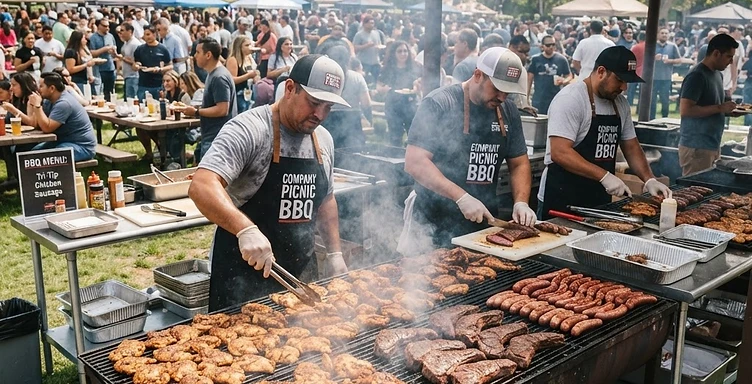
HIGH-VOLUME LIVE GRILL SERVICE — COMPANY PICNIC
Planning timeline and pricing
Large events need lead time. Festivals, corporate picnics and public events should be discussed months ahead — permits, equipment reservations, crew scheduling and organizer coordination all take real calendar time, and peak season dates go early.
Pricing is quoted per person or per station depending on the event structure. The drivers are guest count, number of stations, service window length, crew size, equipment requirements and site conditions. Per-person cost generally improves with volume, while additional stations and extended windows add labor and equipment.
Every proposal is itemized so organizers can present a clean budget line internally. Send us the date, expected attendance, venue and service window, and Chef Alec will come back with a realistic plan — including an honest answer if the scale or timeline is not something we can execute at the standard we hold ourselves to.