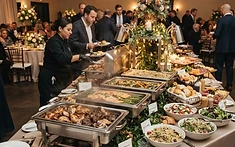

The service style you choose does more than determine how food reaches your guests — it sets the entire rhythm and tone of your event. Appetizer stations and plated dinners are the two most common formats, and they create completely different experiences even with the same menu. This guide explains how each works, when to choose each, and the hybrid option that gives you the best of both.
Two Service Styles, Two Experiences
Appetizer Stations: The Mingling Format
Appetizer stations are a grazing format. Small, composed bites are arranged at stations around the event space, and guests move between them, eating standing up or in conversation groups. There is no seated meal, no line, no structured course. The food is available throughout the event, and the format is inherently social — people move, talk, and eat at their own pace.
This format is ideal for events where the goal is mingling: cocktail receptions, client events, networking gatherings, gallery openings, and parties where the food should support the socializing, not interrupt it. Appetizer stations let 100 people eat without anyone waiting in line, and they keep the room moving.
Our appetizer stations start at $10 per person with no minimum. The $10 tier includes teriyaki chicken cups, corn and bacon succotash cups, classic house salad, and a taco and quesadilla bar. The $12 tier adds beef sliders and Cubano sliders. The $15 tier adds peppercorn meatballs, chipotle prawns, and hibachi cups. The pricing scales with the impression you want to make.
Appetizer Station Tiers
| Tier | Price | Signature Items | Best For |
|---|---|---|---|
| Standard | $10/pp | Teriyaki cups, taco bar, salad | Internal events, staff, casual |
| Mid | $12/pp | + Beef sliders, Cubano sliders | Team celebrations, client events |
| Premium | $15/pp | + Peppercorn meatballs, prawns, hibachi | VIP hosting, executive events |
Plated Dinner: The Structured Format
A plated dinner is a structured meal. Guests are seated, and courses are served one at a time — salad, appetizer, entrée, and optionally dessert. Each plate is composed by the chef and delivered by a dedicated server. The meal has a beginning, a middle, and an end, and it is a defined part of the evening rather than a background activity.
This format is ideal for events where the food is the experience: milestone celebrations, anniversary dinners, small weddings, executive dinners, and any gathering where the meal should feel like an occasion rather than a convenience. The plated format creates a sense of ceremony that stations cannot.

Our plated private dining starts at $100 per person (1-course: salad and entrée) with a $1,000 minimum. The 2-course ($150/pp) adds an appetizer, and the 3-course ($200/pp) adds dessert. The $1,000 minimum means the plated format makes economic sense for groups of 10 or more at the 1-course level, or 7 or more at the 2-course.
The Key Differences
Stations vs. Plated: The Comparison
| Feature | Appetizer Stations | Plated Dinner |
|---|---|---|
| Price | $10–$15/pp | $100–$200/pp |
| Minimum | None | $1,000 |
| Vibe | Mingling, social | Structured, ceremonial |
| Guest interaction | Standing, moving | Seated, served |
| Dietary handling | Self-serve, modular | Pre-plated, pre-arranged |
| Scalability | 30–300+ guests | 10–80 guests |
| Time commitment | Throughout event | 45–90 minutes |
| Best for | Receptions, networking | Celebrations, ceremonies |
The price gap — $10 versus $100 per person — reflects completely different service models, not just different food. Appetizer stations spread staffing and cooking across many guests in a self-serve format. Plated dinner requires a dedicated server, a cook, composed plating, and timed delivery. You are paying for a different kind of event, not just a different quality of food.
When to Choose Appetizer Stations
- The event is a reception, mixer, or networking gathering where mingling is the point.
- The guest count is large (100+) and a seated meal would dominate the evening.
- The event has a wide dietary range and self-serve accommodates it without special orders.
- The budget is limited and a plated dinner is not feasible for the guest count.
- The event has a flexible timeline where people come and go over several hours.
When to Choose Plated Dinner
- The food is the centerpiece of the event — an anniversary, milestone birthday, or small wedding.
- The guest count is 10–80, where plated service is economically and experientially ideal.
- The event calls for ceremony — a structured meal creates a sense of occasion that stations cannot.
- You want a dedicated server and the experience of fine dining in your home or venue.
- The timeline allows for a 45–90 minute seated meal as part of the evening.
The Hybrid: When Both Is the Answer
The choice is not always binary. Many of the best events we cater use both formats — a plated course to open, followed by stations for the remainder. This delivers the ceremony of plated service without committing the entire evening to structured courses, and it is often the best answer for events that are both celebratory and social.
A common hybrid: a plated salad course (the Caesar with bacon, shrimp, and avocado at $25 per person) served to the table as the event opens, followed by appetizer stations ($10–$15 per person) for the remainder. The total — $35–$40 per person — is a fraction of full plated service, and it gives the event both a structured opening and a social main. This is the format I recommend most often for events that are torn between the two.
Another hybrid: a plated entrée with appetizer stations before. The stations handle the mingling portion of the evening, then guests are seated for a plated main course. This works for events that want both a reception feel and a dinner moment — many wedding receptions use this structure.
The Decision Framework
If you are deciding between stations and plated dinner, ask these three questions:
- Is the food the event, or is the food supporting the event? If it is the event, lean plated. If it is supporting, lean stations.
- How many guests, and is mingling or seating the right dynamic? Large groups and mingling → stations. Small groups and ceremony → plated.
- What is the budget per person, and does the $1,000 plated minimum work for your group? Under $30 per person, stations are the answer. Over $100 per person, plated becomes viable.
The format should match the event, not the other way around. A plated dinner at a networking reception is wrong — it traps people in seats when they want to move. Appetizer stations at an anniversary dinner are wrong — they make the meal feel casual when the occasion calls for ceremony. The right service style is the one that serves the event, not the one that sounds more impressive.
A Note on the Taco Bar
There is a third format worth mentioning: the taco bar. It sits between stations and plated in both price ($15 per person) and vibe (interactive but with a full meal). The taco bar is a hybrid by nature — guests move through a line (like stations) but build a full plate (like a meal). For events that want more substance than appetizer stations but less structure than a plated dinner, the taco bar is often the answer. See our complete taco bar catering guide for the full breakdown.
Still deciding between service styles? Tell us about your event and we will recommend the format that fits — including the hybrid option if it is right.